
Politics
Politics
24 Jan, 2026
Contrasting Approaches to Anti-Dynasty Legislation Highlight Challenges in Political Reform
Milagros Bituin
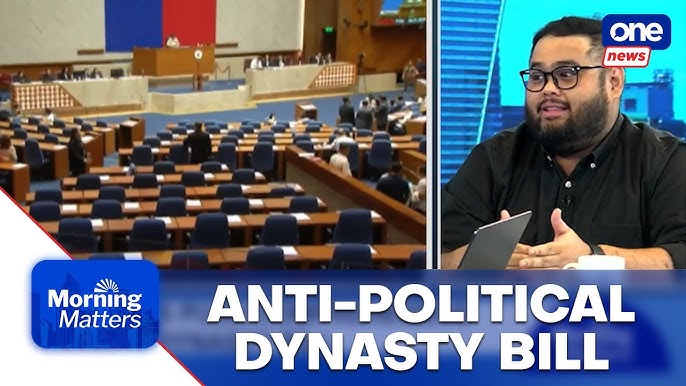
Two competing anti-dynasty bills currently under legislative consideration reveal sharply divergent approaches in addressing the issue of political dynasties, each with distinct implications for reform effectiveness.
One proposal, House Bill 6771 (HB 6771), defines political dynasties narrowly as the simultaneous holding of multiple elected positions by family members. Its primary restriction is against concurrent office-holding, yet it permits strategies such as office rotation, succession, and substitution. This framework allows political clans to retain influence by cycling family members through elected positions, maintaining the essence of dynastic control despite appearing to limit it.
Conversely, House Bill 5905 (HB 5905) adopts a more comprehensive and structural perspective. It conceptualizes dynasties as systems characterized by the concentration and persistence of political power across generations. The bill extends its scope to relationships beyond traditional kinship, explicitly recognizing same-sex partnerships, divorced spouses, de facto unions, and relatives adopted under recent laws. Additionally, it acknowledges corporate co-ownership and shared property as potential channels for dynastic influence, aiming to close loopholes that enable political continuity.
Notably, HB 5905 addresses party-list representation and substitution processes, which HB 6771 overlooks. By including these mechanisms, HB 5905 tackles modern methods by which political families entrench themselves within supposedly sectoral spaces, thereby preserving democratic representation integrity.
Definitions and enforcement provisions further distinguish the bills. HB 6771 leaves terms like "running for office" and "holding office" undefined, creating ambiguity that may be exploited. In contrast, HB 5905 provides clear, actionable definitions tied to candidacy filing and official assumption of duties, facilitating more precise implementation.
Enforcement mechanisms also diverge. HB 6771 relies heavily on pre-canvassing disqualifications and lacks post-proclamation remedies, limiting its capacity to address dynastic entrenchment effectively. HB 5905 establishes a continuous enforcement system allowing electoral commissions to proactively investigate and challenge violations, including post-proclamation actions such as quo warranto proceedings.
Experts observe that under HB 6771, dynastic families can continue manipulating office succession and substitution with minimal legal risk, whereas HB 5905's explicit restrictions make such practices legally precarious.
While HB 6771 offers political expediency backed by influential sponsors, HB 5905 delivers technical rigor grounded in empirical research and long-term data on political dynasties' adaptability. The potential for meaningful reform likely depends on reconciling these bills to combine enforceable measures with pragmatic political support.
Legislators face the challenge of striking a balance between symbolic reforms and substantive structural changes capable of curbing dynastic dominance. Observers emphasize that partial measures risk perpetuating existing power dynamics, undermining constitutional goals of equal public service access and genuine representation.
Key considerations in finalizing legislation include definitions around succession, substitution, party-list nominee regulation, and enforcement post-proclamation. Moving forward, an effective anti-dynasty law must decisively disrupt entrenched familial power networks and safeguard democratic institutions from private interests overriding public mandate.
The ongoing legislative debate is thus a critical juncture in shaping democratic governance and ensuring that political opportunities are open and fairly contested, free from undue familial influence.
Recommended For You

Bacolod City Moves to Boost Food Security with Urban Agriculture Ordinance
Jan 24, 2026
Bonifacio Tumang

Comet 3I/ATLAS Sparks Cosmic Curiosity Amid Alien Spacecraft Speculation
Jan 24, 2026
Filemon Cruzado

Superkit Tour Heads to Thrilling Final Stage at Luisita Golf and Country Club
Jan 24, 2026
Filemon Cruzado
Oriental Mindoro Rep. Rona Leachon Highlights Prolonged Delay at Batangas Port
Jan 24, 2026
Bonifacio Tumang